Translated by William Hunter
The Great War with its death toll in the millions permanently changed our society.
During that conflict women were recruited in trades that until then had been the
exclusive domain of men.
Women were recruited as ambulance drivers, mechanics, and similar jobs. And these occupations opened new perspectives for women and offered new
challenges. With the change of circumstances, new attitudes and modes of behaviour followed.
The motor industry offered opportunities and challengs iin plenty.
When the war was over, only a vestige of the market for automobiles remained. The market had been limited to the well-off
middle-classes. But now a new class of working women wee seen as a powerful influences in the market. And manufacturers were at great rivalry to woo this new potential.
Car racing, rallies and concours d'élégance from that time on were to become the most favoured spot for the privileged class to be seen at the
wheel of the most beautiful racing cars.
From 1923 women were participating in great motoring events like the Bol D'Or.
It was in 1925 that women for the first time put their names down for the Monte Carlo Rally. Mme Mertens in a Lancia, having
left from Tunis, had best time in the third Monte Carlo Rally, but was only placed second, having had only one passenger, her husband. In fact judging was on eight points
basis, with six points attributed for each passenger in the car.
The first feminine automobile club was created in 1926 and by the 83 year old Duchesse d'Uzès, who had also been the first woman to have
obtained a drivers permit as far back as 1898. It was she who signalled the start of the first women's automobile championship in 1927; an event organised by her club, and run
on the Autodrome.
Many competition events were created specifically for women at that time; the best-known being the Paris-La Baule event for women, the Paris St
Raphael Rally for women, the women's Automobile Championship organised by the women's automobile club of Paris and which was made up of a series of events for women which were held every year
from 1927 on the Autodrome.
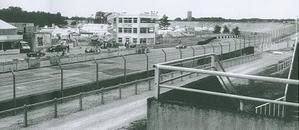
The Autodrome, which opened in 1924, was naturally destined to become one of the high points of motor racing for these new female idols.
Several such women drivers were highly competitive in races that were reserved for women. But record books for all categories
show that some women set standards that were a challenge to many of the best men drivers.
In 1936 the Autodrome featured a series known as "critérium féminin" which was a series of elimination races involving 10 Simca 5s distributed
by lottery.
Here are some of these famous women who completed on the Autodrome.
The English driver
Glenda Stewart was well-known for the records she set at the Autodrome.
She also rode motorcycles, for example a Rudge 350 cc.
In 1930 at theLinas-Montlhery Oval, Miss Glenda Stewart reached 185 km/h, and beat the speed record for one hour driving a three wheeled Morgan.
In a straight line at Arpajon she
set records for the flying mile and kilometre at 117 mph (160 km/h).
In 1932, she set records for the mile, the hour, and 200 km driving a Derby-Miller 1500
cc.
In 1934, she set a record of 234 km an hour for the oval, which stood for many years.
Elisabeth Junek, the Czech driver won the 50 km
handicap on the Autodrome in 1927.
The most celebrated French driver was Mariette-Hélène Delangle, better known as "Hellé-Nice". In 1920 she passed her
driving licence and bought her first car which was a Citroen. A famous dancer, she she was often seen in motor racing circles.
On 2 June 1929, she entered the third Women's Motoring Day at Montlhéry, where she drove an Omega 623 her by the racing driver Daubecq. She was
immediately successful, taking out the Women's Championship run over 50 km, the Women's Grand Prix over 50 km, and the Concours
d'élégance. She soon became the idol of the news media, and it was her face that the company Lucky Strike, used in its publicity, calling their product: "The cigarette the
champion smokes. "
Sometime later, Ettore Bugatti offered her a new challenge of joining the select 200 km/h crowd in a 2 l Bugatti
35C as a promotion exercise aimed at attracting women customers. On the 18th December 1929 at Montlhéry during an officially-conducted test at high-speed run over 10 laps of
the oval, she unleashed a lap at the average speed of 197.7 km/h, and in so doing established a new women's record for the circuit, which now stood at 194.3 km/h over 16 km.
The media made her the most famous woman in France.
In May 1937 she participated, along with four other women, in a record attempt organised by Yacco on the Montlhéry circuit.
Taking it in turns, they drove for 10 days without stopping, the first Matford 3 .621 litre V8 produced in France. After
the withdrawal of Claire Descollas, the attempt took place on the 19th to the 28th of May with Odette Siko team captain, Simone des Forest et Hellé
Nice. The team established 10 world records and 15 international class C. records at average speeds of 140 to 144 km/h. They covered no less than 32,000 km,
gaining, for example, the record for 10 days at an average speed of 139.99 km/h. The Matford, fitted with special bodywork, was baptised Claire, perhaps in honour of the driver
who had to withdraw.
Mmme Schell took part in several events at the
Autodrome. In 1928 she won the Paris -- La Baule automobile event for women.
Mme Anne-Rose ITIER, in 1928, won the second
Grand Prix for women at Montlhéry. She competed five times in the 24 hour Le Mans race between 1934 and 1939
Mme Charlotte Versigny beat the gentleman
drivers to win the 1927 Grand Prix de la Baule, driving a Talbot. She took out the women's championship at the Autodrome in 1928 driving at the Getty ahead of Blanche Meignan
in a Sizaire and Mme Lejeune in a BNC. It was she who inspired Helle Nice to take up motor racing.
MmeViolette Morris was an accomplished
sportswoman, performing at the highest levels in a number of disciplines. She was winner of the Bol d'or Automobile in 1927 driving a Benjamin 1100 cc, third in 1926, fourth in
1922 and 1923, in each case driving a Benjamin cycle car. From 19281932, she managed a motor accessories shop in Paris, Porte de Champerret. She was known to
be quite a wicked lady. http://fr.wikipedia.org/wiki/Violette_Morris.
Mme Odette SIKO was a competitor for times in
the Le Mans 24-hour car race from 1930 to 1933. She finished fourth in 1932. In 1937 she was a participant in the Yacco record-breaking team on the
Autodrome, driving the Matford.
Mme Annet Badel was president of the Georges
Boillot racing drivers club created in 1935 at the Autodrome.
Books :
The Bugatti Queen: In search of a motor racing legend
by Miranda Seymour
Editor : Random House (décembre 2004)
ISBN-10: 1400061687
ISBN-13: 978-1400061686
Femmes pilotes de course auto 1888-1970
by J.-F. BOUZANQUET
Editions ETAI
ISBN : 978 2 7268 8749 3
BUGATTI - ELISKA JUNEK - MA VZPOMINKA JE BUGATTI
OLYMPIA - JUNKOVA Eliska ( JUNEK Elisabeth)
by Eliska Junek and her husband
Violette Morris, la Gestapiste
by Jean-Emile Neaumet
Editor Fleuve Noir: Crime Story
Violette Morris, la Hyène de la gestap
by Raymond Ruffin
Editions Cherche-Midi (2004)
ISBN : 2 74910 224 3
La Diablesse - La Véritable Histoire De Violette Morris
by Raymond Ruffin
Editor Pygmalion (1989)
Look also this URL :
http://speed-queens.mysite.wanadoo-members.co.uk/driver_list.html
In this article, Géo Ham's Drawing com from R&B collection